Jan van der Heyden
3 artworks
Jan van der Heyden (1637–1712) was a prominent Dutch painter and inventor active during the height of the Baroque era. Born in Gorinchem, he settled in Amsterdam, where he developed a reputation for his precision and technical ingenuity. Unlike many of his contemporaries who favored loose brushwork, Van der Heyden utilized a meticulous, near-miniaturist approach to paint that allowed for the representation of complex architectural textures and urban topography with clinical clarity. His work stands as a unique bridge between the traditional Dutch landscape tradition and a proto-scientific fascination with structural accuracy.
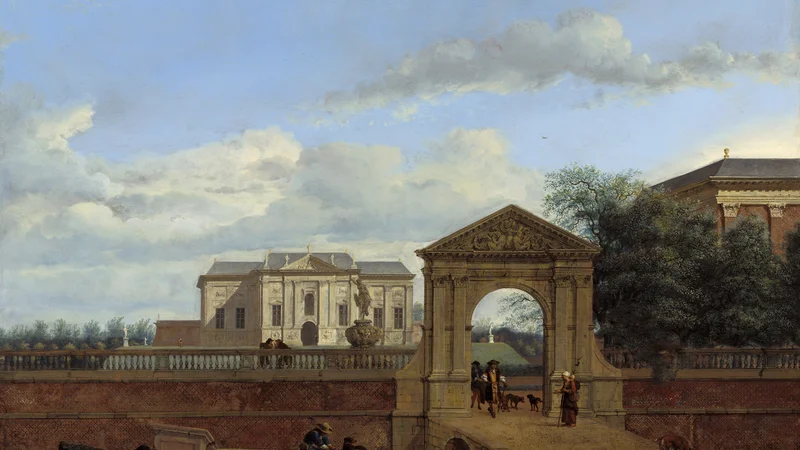
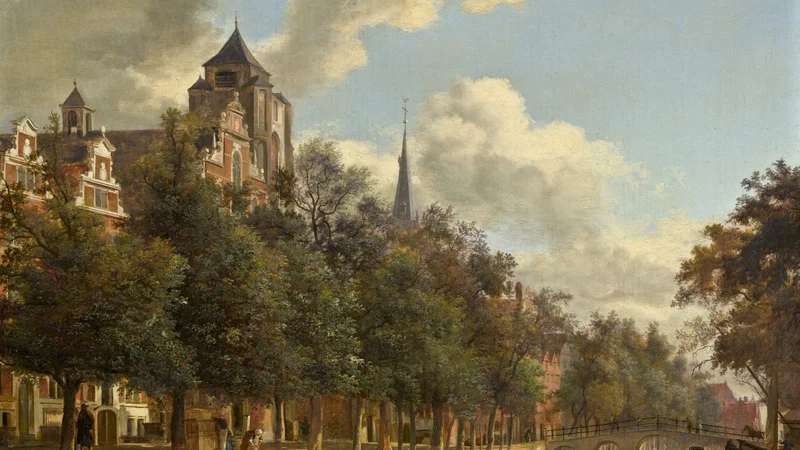
His mastery of light and shadow is best exemplified in compositions such as View of a Town on a Hill and View Down a Dutch Canal, where the visual rhythm is defined by the interplay between solid masonry and the fluidity of water. In works like The drawbridge and The Stone Bridge, he demonstrates a sophisticated understanding of linear perspective, often manipulating spatial arrangements to achieve the refined balance found in An Architectural Fantasy. His ability to render the minutiae of brickwork and stone with such exacting detail imbued his cityscapes with a stillness that borders on the uncanny, revealing a profound preoccupation with the structural order of the seventeenth-century Dutch cityscape.
Beyond his contributions to easel painting, Van der Heyden was a noted inventor who improved the design of fire engines and street lighting, an analytical mindset that clearly permeated his artistic output. His rigorous documentation of the urban environment and his innovative application of glazes to achieve tonal luminosity established him as an influential figure within Dutch art history. By elevating the architectural view to a disciplined, scholarly pursuit, he provided a framework for future generations to explore the relationship between technical precision and atmospheric depth.